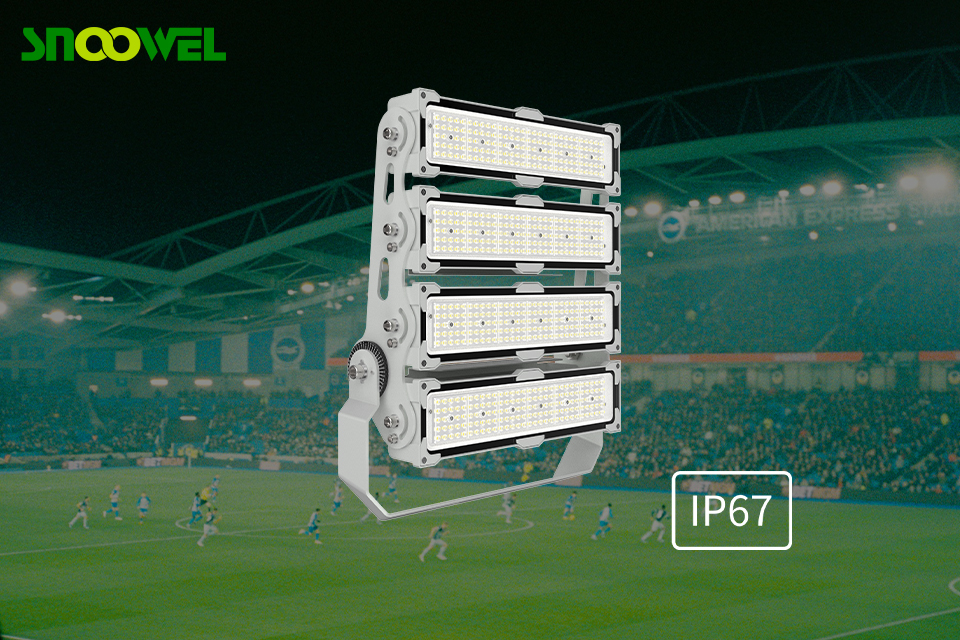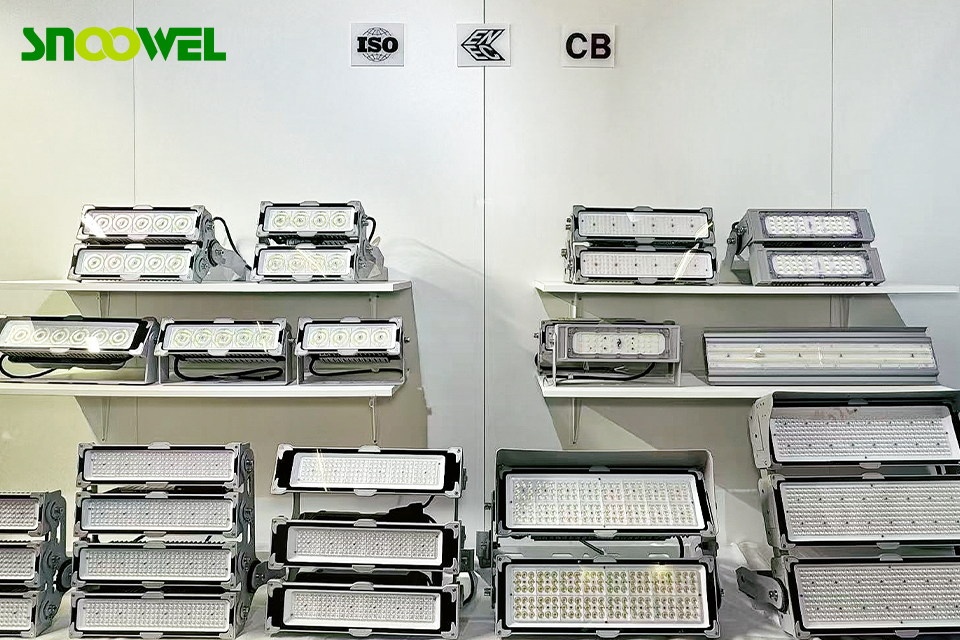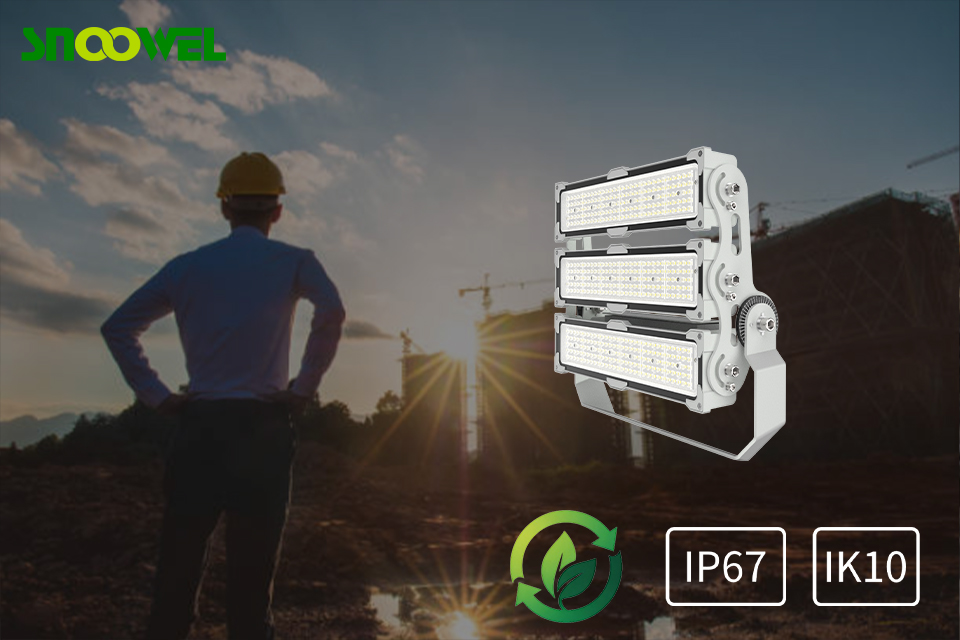
Traditional floodlights (halogen, HPS, metal halide) were fine decades ago — but for harsh outdoor and industrial sites (tunnels, high-masts, coastal parking, sports courts) they’re now a costly liability. IP67 LED flood lights offer vastly superior durability, efficiency & lifetime value. We’ve combined two industry professionals’ perspectives into this comprehensive guide covering seven key differences, the specifics of “IP67” and why SNOOWEL’s TN610 Series is the best replacement option.
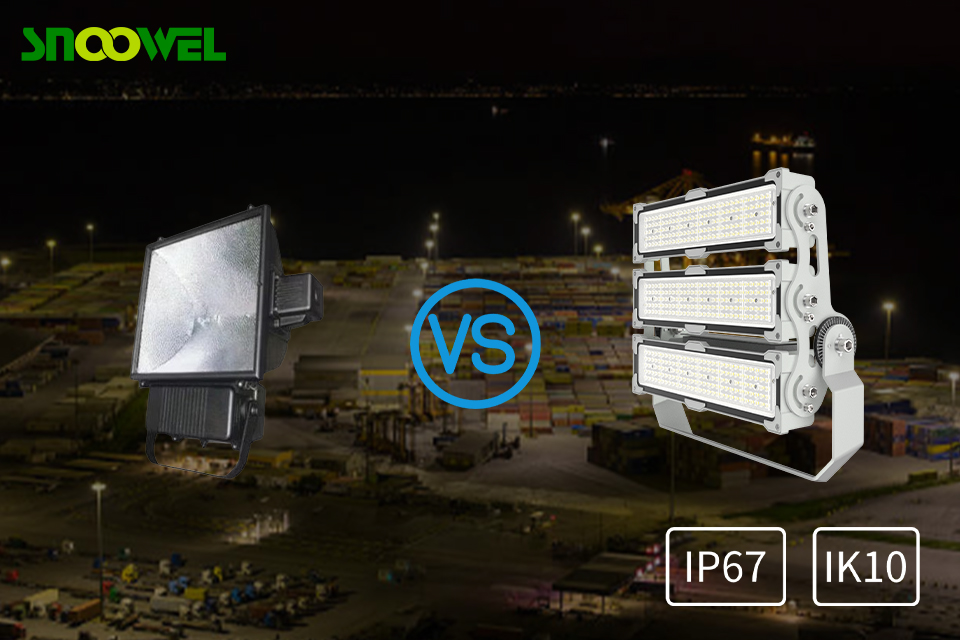
What does IP67 mean — and why it matters
IP6x = completely dust tight (no particle ingress).
IPx7 = protected against temporary immersion in 1 m of water for 30 minutes.
For outdoor and industrial projects where dust, rain, splash, or temporary water exposure are common, IP67 moves a fixture from vulnerable to robust. But IP rating is only the starting point — materials, optics, surge protection and thermal design determine real-world reliability.
7 key differences between IP67 LED flood lights and traditional floodlights
1) Ingress protection & environmental resistance
Traditional: many older HID/halogen floodlights only reach IP44–IP65 and often leak under heavy rain, salt spray or dust storms.
IP67 LED (TN610): dust-tight and immersion resistant. Combined with PC + tempered glass optics, the TN610 prevents dust, water or salt from degrading optics or electronics.
2) Mechanical durability & impact resistance
Traditional: thin housings and fragile lamps—vulnerable to impacts and vibration.
IP67 LED (TN610): die-cast aluminum body with IK09-level toughness; corrosion-resistant housing that also aids heat dissipation.
3) Energy efficiency & operating cost
Traditional: halogen/HID waste a lot of energy as heat; high kWh bills for continuous operation.
IP67 LED (TN610): high-efficiency Lumileds LEDs + quality drivers (Inventronics / Mean Well / Sosen) deliver 50–70% energy savings vs equivalent HID wattages.
4) Lifespan & replacement cycle
Traditional: bulbs typically last 1,000–20,000 hours depending on technology; frequent replacement and ballast servicing.
IP67 LED (TN610): 50,000+ hour lifetime — years of service and much lower total cost of ownership. SNOOWEL supports TN610 with a 7-year warranty.
5) Optical flexibility (beam angles)
Traditional: fixed, limited optics — you often need different lamp types for different tasks.
IP67 LED (TN610): wide optical choices (20°–120°, asymmetric patterns, Type 2/3/4 distributions) so one product suits high-mast, area, sport court, or roadway needs.
6) Electrical stability & surge protection
Traditional: sensitive to voltage fluctuations and surges; ballasts fail under unstable grids.
IP67 LED (TN610): wide input ranges (100–277V, 347V, 480V) and standard surge protection ≥10kV (20kV option) — reliable for remote or industrial power environments.
7) Maintenance & total cost of ownership (TCO)
Traditional: frequent lamp/ballast replacements, cleaning, and repairs drive labor and downtime costs.
IP67 LED (TN610): near maintenance-free operation, dust-tight optics, corrosion-resistant body and long warranty reduce lifecycle costs dramatically.
Quick side-by-side snapshot
| Feature | Traditional (HID/Halogen) | IP67 LED (SNOOWEL TN610) |
|---|---|---|
| IP rating (typical) | IP44–IP65 | IP67 |
| Impact resistance | Low | IK09 |
| Energy use | High | 50–70% less |
| Lifespan | 1k–20k hours | 50k+ hours |
| Beam options | Limited | 20°–120° + asymmetrics |
| Surge protection | Minimal | 10kV / 20kV option |
| Maintenance | Frequent | Minimal |
| Warranty | Short | 7 years (TN610) |
Why the TN610 Series is the practical choice for harsh outdoor projects
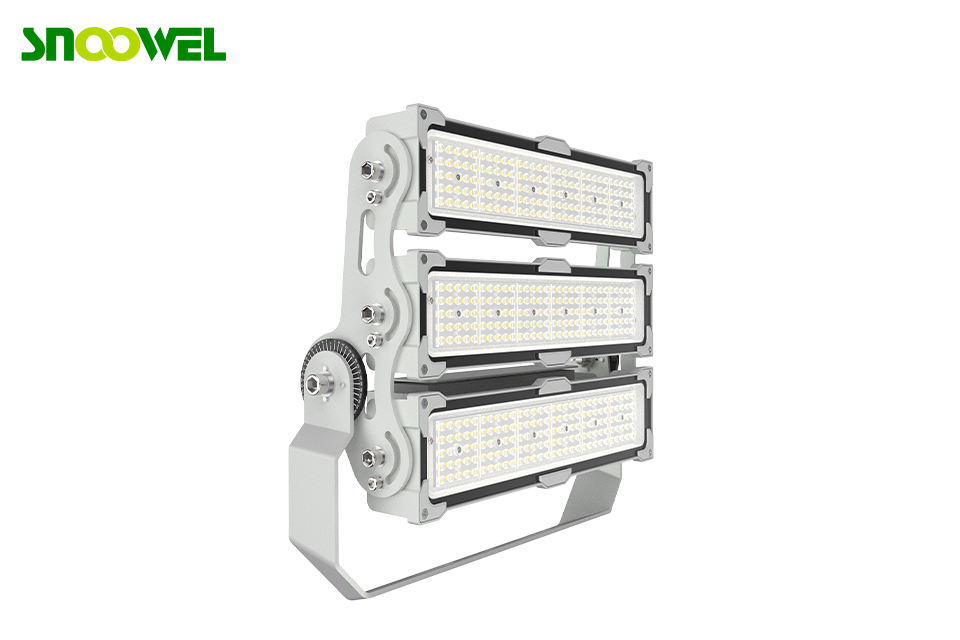
SNOOWEL’s TN610 was designed from the ground up for real-world outdoor demands:
True IP67 sealing plus durable PC + tempered glass optics that resist yellowing and shatter.
Rugged die-cast aluminum housing — improved corrosion resistance for coastal and industrial sites.
Flexible optics: narrow to wide beams and asymmetric options mean one model can serve many applications.
Reliable electrical design: trusted driver brands and strong surge protection protect against grid instability.
High performance: premium LED chips for consistent lumen output and color rendering; instant-on, no warm-up.
Long warranty & QC: 7-year backing and rigorous factory testing reduce deployment risk.
Real-world benefits (numbers that matter)
Energy savings: switching from a 250W halogen/HID setup to a 100W TN610 typically cuts energy use by ~50% while maintaining equivalent lux levels.
Maintenance reduction: lamp replacement cycles drop from years to a single event every decade — fewer lift services, less downtime.
TCO: when you add energy + maintenance + replacement parts, LED IP67 fixtures return payback quickly in most commercial and municipal projects.
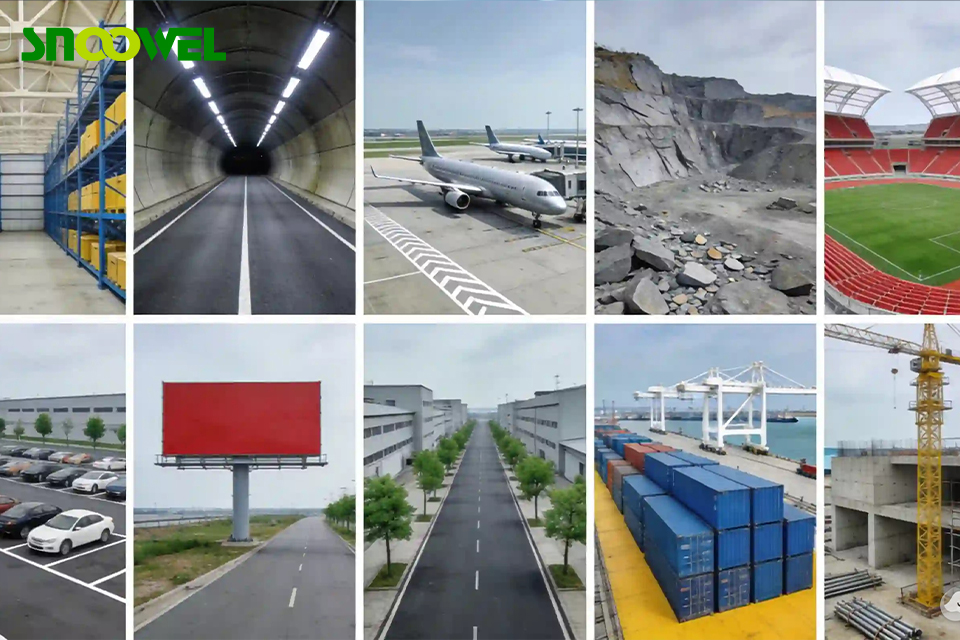
Typical applications where IP67 LED flood lights outperform legacy lighting
Road & tunnel lighting
High-mast areas and ports (salt spray)
Sports courts and stadiums
Parking lots and plazas
Car washes and industrial washdown areas
Billboards and façade lighting
Conclusion — make the switch and stop managing failures
While there are always going to be applications for legacy floodlights, if your project involves exposure to dust, rain/washdown, salt fog, vibration or 24/7 operation – IP67 LED flood lights are an unbeatable long-term solution. Efficiently engineered and designed by SNOOWEL, our TN610 Series offers OEM-level sealing, mechanical durability, optical options, electrical safety, and lifespan in a low-maintenance solution that minimizes total cost of ownership and maximizes lighting quality.
Need a spec sheet or photometrics laid out for your specific site? Want a rough ROI showing how much you’d save by switching from your current HID fixtures to TN610’s? Send me the information on what lamps you’re currently using (type/wattage) at what heights and I can put together a quick comparison along with estimated savings for your project.